Tuesday, August 7, 2012

National Research Council Completes Three-Year Review of USGS Water Quality Program

The National Academies' National Research Council (NRC) has released a pre-publication report resulting from a three-year analysis of the U.S. Geological Survey (USGS) National Water Quality Assessment Program (NAWQA). The report, entitled "Preparing for the Third Decade (Cycle 3) of the National Water-Quality Assessment (NAWQA) Program," provides perspectives of on past  NAWQA Program activities and makes recommendations regarding the current and future design and scope of the Program.  The study is the result of a three-year review of NAWQA by the NRC "Committee on Preparing for the Third Decade (Cycle 3) of the National Water-Quality Assessment (NAWQA) Program."

The Committee's report specifically comments and provides recommendations on:
  1. Present and future water-quality issues that should be considered for addition to the NAWQA Program's scope;
  2. NAWQA Program components that should be retained or enhanced;
  3. Opportunities for NAWQA to better collaborate with others in pursuing Program objectives;
  4. Technical soundness of strategic science and design plans for  NAWQA's third decade; and
  5. NAWQA Program ability to meet objectives entering into the Program's third decade.
In its report, the Committee notably recommends that NAWQA:
  • "Focus on core mission areas where it has unique capabilities, for the program’s own implementation efforts;
  • "Leverage resources with other agencies to achieve more of the objectives of the Cycle 3 Science Plan;
  • "Foster higher levels of involvement and investment by other agencies;
  • "Help others design their own programs to meet identified national objectives of the Cycle 3 Science Plan without NAWQA’s direct involvement;
  • "Explore incentives, for example, access to NAWQA technical assistance, which will enable more sharing of effort for data collection, analysis, and technological innovation across the entire program."

You can view the report’s Table of Contents and read it in full by clicking this link.

Friday, August 3, 2012

Mississippi River Basin Water Resource News for the Week

~Virtual Newspaper for an Aquatic World~

NOAA Scientists Measure Small Gulf Hypoxic Zone; Link Size Reduction to Drought Conditions
The National Oceanic and Atmospheric Administration's ("NOAA's") National Centers for Coastal Ocean Science (or NCCOS) announced on July 27 that its scientists had observed the fourth smallest hypoxic or oxygen-free zone in the northern Gulf of Mexico since record-keeping began in 1985. Drought conditions in the country's midsection are largely believed to have directly resulted in the "dead zone's" smaller than average size (2,889 square miles).  Read more related articles under "Water Quality," below, and in this earlier blog article.

Showcase, Short-term Farm Disaster Aid Package Passes House - Going Nowhere Fast 
While the worst U.S. drought in 56 years intensified, late yesterday afternoon, House Republicans pushed through a largely showcase, short-term $383 million package of loans and grants for livestock producers and a limited number of farmers. The House disaster relief bill (HR 6233) focuses on providing loans and grants to producers of livestock and fruit trees impacted by the drought during the current (2012) Fiscal Year, and would pay for its $383 million price tag by capping the Conservation Stewardship Program and Environmental Quality Incentives Program during Fiscal Year 2013. While the bill will give farm state House Republicans political cover when they go home to face drought-stricken farmers, the prospects for its consideration by the Senate are slim and its likelihood of enactment into law effectively non-existent. To read details of the House bill, its prospects, and its relation to the comprehensive farm bill, see this article.

Notable @UpperMiss Twitter Postings for the Week
Drought-
Conditions
  • Drought intensifies in most-parched areas of U.S. http://wapo.st/OtA9vu
  • Worst US drought in 56 years intensified over the past week bit.ly/M1wuGd
  • USDA designates 98 Illinois counties disaster areas; no drought relief predicted through October http://trib.in/N0NmM2
  • USDA's addition of 218 counties yesterday means >half of all US counties are designated disaster areas http://bit.ly/RfpF0x
  • Where Things Stand - Drought, Heat, Crop Futures and Groceries http://bit.ly/OEaIZd
  • Drought and soaring temperatures are leading to unprecedented warmth in U.S. Midwest lakes, streams and rivers http://usat.ly/Rf7cRv
  • South-central US likely to see triple-digit heat throughout this weekend and into first full week of August http://bit.ly/T3aXMQ
  • About 2/3 of Nebraska now in extreme to exceptional drought; a week ago number was 5%; Iowa goes from 0 to 25% http://bit.ly/NMBMCN
  • First significant rainfall in more than a month drops about a half-inch across most of Iowa; state still "parched" http://dmreg.co/QKplqa
  • Scientists warn it’s the "new norm" after worst drought in 800 years http://soc.li/CpcRcCf
Impacts
Federal Policy
Farm Bill-
  • Heritage Action for America op-ed urges breaking massive farm bill "into manageable, understandable pieces" http://on.wsj.com/No0bM0
  • Ag Committee Chair Lucas "riding herd" on GOP effort to produce House Farm Bill nyti.ms/NnZH8B
  • Iowa Congressmen urge quick vote on the farm bill: http://bit.ly/PHpMno
  • Rep. Braley (D-IA) will seek to force House vote on five-year Farm Bill package using "discharge petition" process http://dmreg.co/NnZMJv
  • Dan Glickman and Jim Moseley Op-ed: Decades of farmland conservation gains at risk http://bit.ly/OFlKKe
Agriculture -
  • Church, social service foster urban farming in Des Moines, Iowa http://bit.ly/QKStxr
  • U of WI researchers & companies receive $7M fed grant to evaluate ethanol production from cow manure; Manitowoc Co, WI http://bit.ly/QWAN6z
  • Global grains powerhouse Cargill urges U.S. government to temporarily curb its ethanol quotas as corn supply drops http://reut.rs/Pmr5ok
  • No-Till Travels Better than a Farm Bill Extension http://bit.ly/OntqjO (via @ChrisClaytonDTN)
  • MN Supreme Court reverses appeals court decision: says drifting pesticides from farm don't constitute trespassing http://bit.ly/NbcFHH
  • Environmental groups question EPA on withdrawal of livestock information-gathering rule http://bit.ly/Rf2K5j
Water Quality -
Water Resource Management (Floodplains, Dams, Navigation, Wetlands, Flooding, etc.) -
  • Army Corps warns of dredging on falling Mississippi River and tributaries without a permit http://bit.ly/MSn0bv
  • Awards "roll in" for Greater New Orleans Hurricane and Storm Damage Risk Reduction System http://bit.ly/LV7xGM (PDF file)
  • Over prolonged period, water consumption in Minneapolis and St. Paul (MN) has been declining steeply and steadily http://bit.ly/LVccZa
  • Army Corps will continue to release water from upstream KS reservoirs to provide navigation support on Missouri River http://bit.ly/NMyH5R
  • Missouri River drought impacts diluted by releasing northern reservoir water reserves, while Mississippi River hit hard http://bit.ly/MVD2Vq
  • Des Moines Water Works ended July with record high water usage amid historic drought and water conservation plan http://dmreg.co/RfcsVv
  • Army Corps of Engineers presents plans for West Bank (LA) wetland restoration projects to mitigate levee-caused losses http://bit.ly/RfdEbd
In the States -
  • New WV appeals board decision is demanding tougher mining permit reviews and tightening water quality limits http://bit.ly/Rf9EYv
  • MO DNR to hold public meeting on permitting for coal ash landfill at Ameren Missouri's Rush Island power plant http://bit.ly/RfaBQv
Forestry -
  • USDA Blog: Secretary's Column: Managing our Forests to Drive Job Growth http://ow.ly/cylCG
Biodiversity, Wildlife and Invasives -
Gulf Coastal Region-
  • Army Corps: no action should be taken on $2.9B Mississippi River-Gulf Outlet restoration plan because LA won't pay 35% http://bit.ly/MVDNxI
  • Mississippi River Delta Restoration Campaign's "Delta Dispatches" July 30 issue http://bit.ly/MVOXCJ
Resource Extraction -
  • Appellate court rules for towns in PA fracking suit; overturns key parts of state's new natural gas development law http://lat.ms/LV9zqv
  • Nationwide Insurance announces it won't offer coverage for property damage caused by hydraulic fracturing http://bit.ly/MVCHlF
  • WI business group urges Mining Association not to discuss mining bill with Dems/environmentalists until after election http://bit.ly/SWtryk
  • WI iron mining areas extend into Mississippi River Basin; map here: http://bit.ly/LVbhrS
  • IL DNR denies permit for 600-acre coal mine in Illinois River floodplain and near town and wildlife area http://cbsn.ws/NbaEex
Federal Budget -
Events-
  • Volunteers pluck trash from low Cedar River during 25th Annual River Cleanup bit.ly/MOme4z
  • Pathways to Success conference: Integrating Human Dimensions into Fish & Wildlife Management; Breckenridge, CO; 9/24-27 http://bit.ly/y3WUzz
  • Upper Mississippi River Basin Association meetings scheduled for August 28-30; La Crosse, WI http://bit.ly/d1ksBR (open to public)
  • NRC meeting on Levees & the National Flood Insurance Program: Improving Policies & Practices; August 15; St. Louis, MO http://bit.ly/Psqx02
  • Celebrate National Farmers Market Week! — August 5-11 http://bit.ly/OEhfTQ
  • 32nd International Symposium of the North American Lake Management Society; Nov 7-9 Madison, WI http://bit.ly/OFkoPA
e-Newsletters, Publications and Journals -
  • American Farmland Trust's July e-newsletter, including MN and WI farm conservation coverage http://bit.ly/Og2xhK
  • Mississippi River Delta Restoration Campaign's "Delta Dispatches" July 30 issue http://bit.ly/MVOXCJ
  • Tennessee Clean Water Network July 31 e-newsletter with special nutrients and fracking coverage http://bit.ly/QfwLEo
  • From the Council for Agricultural Science & Technology: "Water & Land Issues Associated with Animal Agriculture: A U.S. Perspective" abstract; free download: http://bit.ly/OIWogt
Other news-
  • "Heat in the Heartland: 60 Years of Warming in the Midwest" looks at five major Midwest urban areas bit.ly/OTxd7j
  • Senators introduce revised version of legislation to preempt U.S. EPA regulation of coal ash disposal http://bit.ly/OFn9R8
Political Scene -
  • Poll finds Sen. McCaskill (D-MO) down in Missouri's US Senate race; trailing all 3 possible GOP opponents http://bit.ly/Qy7fHU
  • Rep. Geoff Davis (R-KY-4) resigns from Congress, effective immediately http://politi.co/OCLeLE
  • Former WI Governor Thompson locked in a three-way fight for Wisconsin’s GOP US Senate nomination http://wapo.st/RffYPz
  • August primaries can end careers of some US Reps; possibles include Akin, Clay, Carnahan (MO); Black (TN) http://bit.ly/RfnF8g
  • Chuck Fleischmann (R-TN-3) wins U.S. House seat primary in redrawn Tennessee district http://bit.ly/OFmwqF
Last Word -
"Like its politicians and war, society has the teenagers it deserves." - Joseph Priestley, who, on August 1, 1774, "discovered" oxygen, after conducting his most famous oxygen-generating experiment (heating mercuric oxide in an inverted glass container).  He isolated an "air" that appeared to be completely new, and called his discovery "dephlogisticated air."

Showcase, Short-term Farm Disaster Aid Package Passes House - Going Nowhere Fast

While the worst U.S. drought in 56 years intensified, late yesterday afternoon, House Republicans pushed through a largely showcase, short-term $383 million package of loans and grants for livestock producers and a limited number of farmers. The House disaster relief bill (HR 6233) focuses on providing loans and grants to producers of livestock and fruit trees impacted by the drought during the current (2012) Fiscal Year, and would pay for its $383 million price tag by capping the Conservation Stewardship Program and Environmental Quality Incentives Program. The measure passed 223 to 197 (roll call vote list here), with 35 mostly farm-state Democrats joining Republicans in support. Democrats voting against the bill objected to the manner in which the farm legislation has been handled, while some Republicans who voted against the bill objected to its high costs. Most Democrats held out for the broader bill, and also objected to the bill's GOP author's manner of offsetting costs by cutting conservation program funding.

While the bill will give farm state House Republicans political cover when they go home to face drought-stricken farmers, the prospects for its consideration by the Senate are slim and its likelihood of enactment into law effectively non-existent. Senate Majority Leader Harry Reid (D-NV) said earlier in the week that he would be happy to call up anything the House passes, as long as it looks similar to the disaster-aid provisions that the Senate passed in June as part of its five-year farm bill. It does not. The Senate-passed measure would help a broader range of agricultural producers than does the House GOP bill. But while on the surface it might look as if the Senate is blocking further action on disaster aid, the opposition to the House's one-year disaster assistance approach is much broader than that. Farm and conservation groups largely favor providing disaster aid, but what most actually want is a comprehensive five-year farm bill (one that includes disaster provisions that would preclude Congress's need to address drought and flood losses on an annual basis). And those groups are concerned that passing the GOP version of short-term drought aid might delay Congressional consideration of the long-term, comprehensive farm bill even more than it has already been.

Senator Debbie Stabenow (D-MI), who chairs the Senate Agriculture Committee, took to the Senate floor soon after the House disaster aid bill vote to say that lawmakers would work informally over their August recess to try to put together a new disaster relief measure to present to Congress when it meets again in September; a bill more consistent with the Senate's approach.

On the issue of farm bill passage, House Speaker John Boehner (R-OH-8) on Thursday showed no signs of moving the measure to the House floor anytime soon, noting that the farm bill passed out of the House Agriculture Committee lacks the support needed to move beyond the House, primarily because of divisions over food-stamp funding in the farm bill's nutrition title. Boehner stressed, "Frankly I haven’t seen 218 votes in the middle to pass a farm bill."

Wednesday, August 1, 2012

Where Things Stand - Drought, Heat, Crop Futures and Groceries

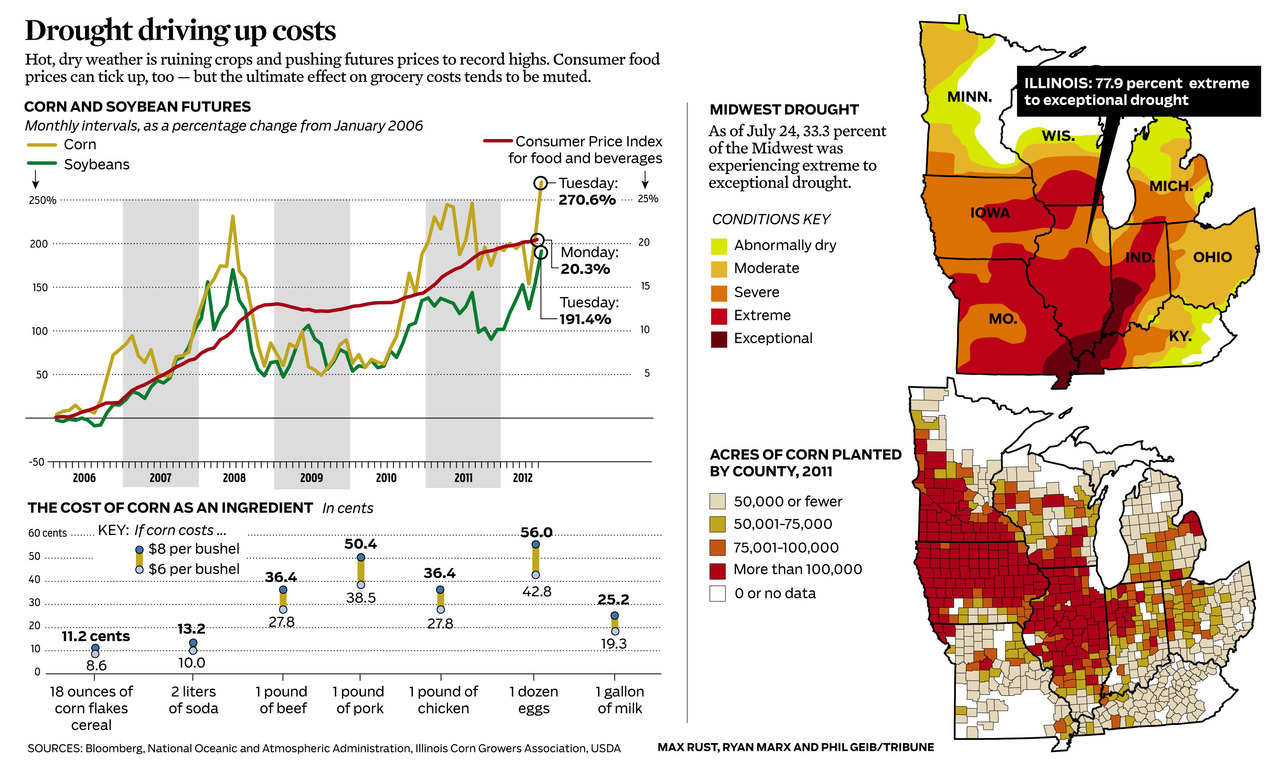
Hot, dry weather is ruining crops and pushing futures prices to record highs. Consumer food prices tick up, too, but the ultimate impact on grocery costs tends to be muted. (graphic from Chicago Tribune).


Stand-alone Agriculture Disaster Relief Bill Released

House leaders have released the text for the new farm disaster relief bill to "make supplemental agricultural disaster assistance available for fiscal year 2012 with the costs of such assistance offset by changes to certain conservation programs, and for other purposes." The House is expected to vote on the stand-alone drought relief bill on Thursday before Members leave for the Congressional five-week recess. The substitute will restore livestock indemnity and forage programs that have expired, with some assistance also being provided for specialty crop producers.  The disaster aid would be paid for by capping the Conservation Stewardship Program and Environmental Quality Incentives Program during Fiscal Year 2013.

For more background, see this earlier story on the development of this bill as a replacement to the earlier House GOP one-year farm bill extension bill proposal.

UPDATED (August 1 - 1:59 PM): One-Year Farm Bill Extension Pulled in Favor of Stand-alone Disaster Relief Bill

Facing likely defeat, the GOP pulled its one-year farm bill extension bill from today's House docket in favor of a narrower, $383 Million disaster aid bill. The House Rules Committee late on Tuesday pulled the farm bill extension from its agenda at the last minute, essentially killing any chance that it would be voted on this week by the House. The House instead will be voting on a stand-alone drought relief bill; probably on Thursday before Members leave for the Congressional five-week recess. The substitute will restore livestock indemnity and forage programs that have expired, with some assistance also being provided for specialty crop producers. To reduce costs below those provided in the combined one-year Farm Bill - disaster relief bill (which provided for both 2012 and 2103 relief), the aid under the stand-alone will apply only to 2012. That represents a reduction of about $256 million below the relief costs included in the one-year farm bill extension. Offsets to pay for the disaster relief will reportedly come from imposing caps on two conservation programs, mirroring a House Appropriations Committee cap proposal contained in its Fiscal Year 2013 USDA appropriations bill.

Assuming the House bill passes, the Senate will face pressure to also pass the measure before week's end. There is an outside chance that it may actually wait until after Senators return from their August recess to consider the House bill or a Senate counterpart.  Sen. Jeff Merkley (D-OR) is said to have filed on Tuesday morning a similar drought relief bill in the Senate.  Earlier this month, Merkely had sponsored S. 3395, the Wildfire and Drought Relief for Ranchers and Farmers Act of 2012; however that bill called for funding the aid with funds from the Commodity Credit Corporation.

While Senate Republicans have expressed a willingness to take up the bill and approve it before next week, prior to the Republican announcement, Democrats had been divided on how to proceed if the House presented a disaster aid-only bill. Some Democrats, notably Senate Agriculture Committee Chair Debbie Stabenow (D-MI), continued yesterday to press for a full five-year Farm Bill approach. However, Senate Majority Leader Harry Reid (D-NV) left the door open to considering a stand-alone disaster bill, saying about the House yesterday that "if they want to do something about drought relief, send that to us." .

UPDATED: House Committee Passes Three Controversial Bills Limiting EPA Powers

UPDATE: The House Transportation and Infrastructure Committee on Wednesday approved the three bills discussed in an earlier blog posting below. The bills would limit the U.S. EPA's regulatory authority under the Clean Water Act.
The House Transportation and Infrastructure Committee will meet on Wednesday to consider three bills it deferred from considering last week, following complaints by Democratic Committee members that they had not had ample time to read the bills. The bills included two that would limit the U.S. EPA's Clean Water Act powers relating to logging road runoff and wetland delineation, and one limiting EPA's ability to conduct farm flyovers. A fourth bill will also be considered. That one is H.R. 5806, the "Outreach to People with Disabilities During Emergencies Act." The Committee meeting web site is here (where you can link to each of the bills and watch a live, streaming webcast of the mark-up meeting).

The three bills to be considered today are:
  • H.R. 4278, cosponsored by Reps. Robert Hurt (R-VA) and Jason Altmire (D-PA), which would eliminate limits on the regulatory exemptions provided in the Clean Water Act for agricultural activities. 
  • H.R. 2541, sponsored by Rep. Jaime Herrera Beutler (R-WA), which would prohibit the EPA from requiring a water pollution permit for silviculture.
  • H.R. 5961, sponsored by Rep. Shelley Moore Capito (R-WV), which would amend the Clean Water Act to prohibit the EPA from conducting aerial surveillance of farmland without voluntary written consent, public notice and a certification of reasonable suspicion that a violation has occurred.