Thursday, January 16, 2014

Spending Bill Will Delay Flood Insurance Rate Hikes While Related Legislation Progresses In Senate

Within the federal omnibus fiscal year 2014 spending bill  passed by Congress this week is a provision that will suspend until November 2014 flood insurance premium rate increases under the National Flood Insurance Program (NFIP); rate hikes due to be implemented under NFIP revisions enacted in 2012 (in the Flood Insurance Reform Act of 2012; see below).  The omnibus language retains scheduled premium increases for vacation houses, for businesses and for frequently-flooded properties, as well as a requirement that drops federal insurance subsidies whenever a home is sold.

In the meantime, 30 Senate co-sponsors, mostly from coastal states, are backing the "Homeowner Flood Insurance Affordability Act" (S. 1846), (introduced by Sens. Robert Menendez (D-N.J.) and Johnny Isakson (R-Ga.)).  That bill would delay for four years the implementation of certain provisions of the 2012 Flood Insurance Reform Act, including rate increases intended to help the NFIP become financially solvent by bringing rates more in line with actual flooding risks.  The Homeowner Flood Insurance Affordability Act may see formal Senate consideration as early as this month.

The following overview and related references are provided for background on the NFIP, its history of financial insolvency, and the most recent (2012) substantive attempt to reform the program.
   
National Flood Insurance Program
Established in 1968 through the National Flood Insurance Act of 1968 (P.L. 90-448), the NFIP
is administered by the Federal Emergency Management Agency (FEMA) for two major objectives: first, to pool risk and help guarantee flood insurance availability; and second, to encourage the development of local floodplain management regulations and building standards that reduce flood risks, damages and costs.  Property owners in communities that have adopted FEMA’s Flood Insurance Rate Maps (known as “FIRMs”) become eligible for NFIP flood insurance policies.  The maximum coverage for single- and multi-family dwellings is $250,000. Commercial property owners can purchase policies covering up to $500,000 in losses.  Owners of residential properties within designated flood risk areas with federally-backed mortgages are required to purchase NFIP policies.

Unlike typical insurance policies (such as automobile or homeowner’s insurance), where insurers issue policies with risk-based premiums (i.e., policyholders that are more at risk pay more for their insurance coverage), the actual premiums that policyholders pay for flood insurance do not accurately reflect their property’s flooding risk.  This is because FEMA administers the NFIP by providing only limited (capped) coverage and by subsidizing many policies, including properties that are most at risk of flooding and buildings built prior to the adoption of FIRMs. 

Flood Insurance Premium Subsidies
As NFIP was first being implemented in the 1970s, premium subsidies were believed to be necessary because property owners in higher flood-risk areas could not accurately estimate flood risk (no flood insurance rate maps were available), and because the prospect of receiving subsidies was thought to provide an incentive for local communities to participate in the NFIP (by developing local floodplain management regulations and building standards). It was the intent of the federal government to phase out insurance premium subsidies as local floodplain management practices were strengthened.

Had that phase-out occurred as intended, the NFIP should have ultimately reduced the federal government’s responsibility for flood losses.  However, rate subsidies have remained in place, and the NFIP has become financially insolvent while failing to meet  the original 1968 Act objectives (noted above).  (When it cannot fulfill its claim responsibilities, the FEMA borrows money from the U.S. Treasury to pay its NFIP claims.)

National Flood Insurance Act Amendments
The NFIP has been amended several times since 1968 (including in 1973, 1982, 1994 and 2004).  Most recently, the Biggert-Waters Flood Insurance Reform Act of 2012 reauthorized the NFIP through September 30, 2017, and amended the 1968 law in an effort to improve the NFIP’s financial solvency and limit federal exposure to flood loss costs (the Biggert-Waters Act became law under Public Law No: 112-141).  The intent of the Act is to provide insurance premium rates that accurately reflect flood risk, based on the understanding that higher insurance costs are necessary to signal actual risk.

Based on flood risks represented by FIRMs, the Biggert-Waters Act would eliminate federal insurance subsidies and reduce a cap on annual premium increases, thus making flood insurance premiums more realistically risk-based than in the past. The Biggert-Waters Act also would eliminate insurance payments for properties that experience severe repetitive flooding losses.

Flood Insurance Rate Maps
FIRMs are used in part to determine flood insurance rates, control floodplain development through establishment of building codes, and communicate flood risk to the public. However, FIRMs are based on retrospective evaluations of past conditions and have been shown to be inaccurate predictors of future flood risk.  This inherent inaccuracy has been a major challenge to FEMA as it attempts to determine accurate flood risks and associated insurance rates.  Further, the inaccurate maps communicate a misleading message to property owners and local planning officials, as they attempt estimate risks related to developing, building or staying in flood-prone areas.  

FEMA is currently in the process of updating its maps through a Risk Mapping, Assessment and Planning (or “Risk MAP”) process designed to “deliver quality data that increases public awareness and leads to action that reduces risk to life and property,” according to FEMA.  The Risk MAP updates will almost certainly increase the number of properties that fall under the purview of NFIP, but will also very likely still underestimate the number of people and properties at risk of flooding; in part because Risk MAP updates are not permitted to incorporate future climate change-influenced flooding scenarios (predicated upon rising sea levels, or increased storm intensities, for example).
-------------------------------
Additional resources

Friday, January 10, 2014

Mississippi River Basin Water Resource Weekly News

~Virtual Newspaper for an Aquatic World~

Save the Date! - Significant 2014 Mississippi River Basin Water Policy Dates and Deadlines
The Julian calendar has turned from 2013 to 2014, and we have prepared a chronology of nine dates and months to make note of in 2014 that may prove to be significant within the Mississippi River Basin water policy arena. You can see that listing here.

Army Corps' Great Lakes and Mississippi River Interbasin Invasive Species Analysis Presents Options; Not Recommendations
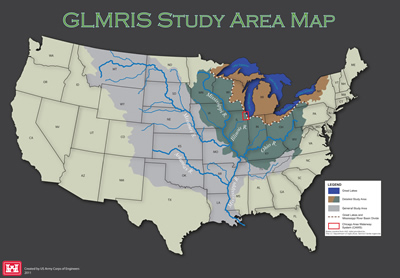
On January 6, the Army Corps of Engineers released a report offering a range of eight alternatives that might prevent or mitigate the transfer of invasive species between the Great Lakes and Mississippi River basins. The eight options were detailed in the congressionally-mandated report entitled "Great Lakes and Mississippi River Interbasin Study" ("GLMRIS") and range from taking no additional federal action beyond what is being done now, to complete hydrological separation the basins at select locations. Significantly, the GLMRIS report neither makes recommendations nor prioritizes the various options. The report simply presents each of the eight alternatives, including its general location, a description of its conceptual design elements, an estimated implementation time, and estimated project cost. You can read more stories on the issue, below, under "Biodiversity," and our summary of the report findings, including detailed directions regarding how to comment on the report, here. The entire GLMRIS report is available at this Army Corps' web site.

New Report Recommends Areas of Improvement for USDA Mississippi River Water Quality Initiative
Fiscal Year 2012 Mississippi River
Basin Healthy Watersheds Initiative
Priority Watersheds (click to enlarge)
The World Resources Institute (WRI) released a working paper on January 7 entitled “Improving Water Quality: A Review of the Mississippi River Basin Healthy Watersheds Initiative (MRBI) To Target U.S. Farm Conservation Funds.” In its report, WRI reviewed the U.S. Department of Agriculture (USDA), Natural Resources Conservation Service's (NRCS) Mississippi River Basin Healthy Watersheds Initiative (MRBI), seeking to determine the extent to which the MRBI is achieving its goal of realizing measurable improvements in water quality. Based upon its analysis, WRI identified twelve "specific recommendations for MRBI that may assist NRCS and its project partners in achieving measurable improvements in landscape-scale water quality outcomes." The complete 35-page WRI report is available on-line to read and download here, and an overview of the report's findings can be found in this blog post.


Noteworthy @UpperMiss Twitter Postings for the Week 

Water Quality -
  • Testimony and statements from Natural Resource Committee Thursday hearing on Administration rewrite of George W. Bush-era stream buffer zone rule ow.ly/siPPL
  • USEPA appeals federal court decision that it cannot require WV poultry operation to obtain CWA stormwater permit ow.ly/siPkq
  • Sioux City (Iowa) studies addition of wastewater treatment plant phosphorus, nitrogen removal before guidelines are mandatory http://ow.ly/sjh0E
  • Louisiana Department of Agriculture and Forestry official comments on environmental groups' water quality nutrient standard lawsuit http://ow.ly/sl7bB
  • Two companies will settle northwestern Wisconsin sand mine pollution case where sediments infiltrated wetland, stream and St. Croix River http://ow.ly/slt17
  • Iowa Nutrient Reduction Strategy set to enter next phase with eight watershed demonstration projects http://ow.ly/sm4JP
  • Wetland contamination with brine can be predicted in oil boom states, USGS study finds http://ow.ly/sq2mk
Water Resource Management (Floodplains, Dams, Navigation, Wetlands, Flooding, Supplies, etc.) -
  • Next "Dredgefest" (in Louisiana) to focus on the Mississippi River: "A Land-Making Machine" (at least it used to be) http://ow.ly/ss9Vi
  • Sen. Barbara Boxer’s deal-making with GOP on water resources' bill (WRDA) "streamlining" upsets environmental allies http://ow.ly/slcdE
  • Majority Leader Cantor: House could hold final vote on $8.2 billion WRDA bill to fund US port and waterway projects this month http://ow.ly/sjfFt
  • "The Great Flood": Hauntingly Poetic Documentary Recounts the Worst Flood in US History: Great Mississippi Flood of 1927 ow.ly/sl6F3
  • Interior Secretary terminates program designed to recognize and promote the conservation of valuable watersheds ow.ly/siP1s
  • Ohio River could soon be a thoroughfare for barge-carried fracking waste, worrying residents in the Cincinnati region ow.ly/siKZ5
  • Sen. Bob Menendez (D-NJ) calls on Congress to pass bill that would stop flood insurance rate increases http://ow.ly/sjg14
  • Senate may soon take procedural vote on flood insurance rate hike delay bill http://ow.ly/sm2b3 (bill information here: http://ow.ly/sm2iJ)
  • Bill to delay flood insurance premium rate increases could get test vote in Senate soon ow.ly/spMch
  • CBO report on the cost of implementing bill to reduce insurance premium rates under National Flood Insurance Program: ow.ly/sno7g
  • FEMA tasks National Academies to review its system of pricing flood insurance for homeowners at low elevations http://ow.ly/slbid
  • Updated Illinois Waterway Navigation Charts now available (Illinois River from Mississippi River to Lake Michigan) ow.ly/spOvz
  • Nearly 70 barges backed up on either side of broken lock connecting Mississippi River and Gulf Intracoastal Waterway http://ow.ly/ss9uh
  • Review begins of Louisiana's plans to build diversions of sediment and freshwater along Mississippi and Atchafalaya rivers http://ow.ly/sq2VM
  • Plans announced for new deep water dock at St. James, Louisiana, located on the Mississippi River http://ow.ly/ss8Fm
  • 2014 Missouri River runoff season begins; reservoirs drawn down significantly due to lingering 2012 drought effects http://ow.ly/ss8rl
Farm Bill-
  • Senate Agriculture Committee Chairwoman stresses need for a dairy compromise in order to complete stalled farm bill http://ow.ly/ss4oR
  • House Agriculture Committee Chair: final action on farm bill conference report now likely to slip into late January http://ow.ly/sqTuL
  • Agreement reached on cuts to food stamps, but farm bill talks hit snag on dairy and catfish programs http://ow.ly/sqT9U
  • Fight over dairy provisions is threatening to hold up completion of the farm bill this week ow.ly/spKGx
  • Sen. Stabenow optimistic on farm bill passage, even as tensions reemerge over dairy support issues ow.ly/snomg
  • Pressure grows on Republicans to pass a new farm bill for the most basic of reasons: political survival ow.ly/siK8h
  • Farm and conservation groups look to farm bill reauthorization to reverse conservation fee budget provision http://ow.ly/slaWY
  • Farm bill negotiators are signaling a bill breakthrough is imminent on an impasse that began 15 months ago http://ow.ly/sldSD
  • Limited House January floor time and GOP opposition to small nutrition cuts could still derail a compromise farm bill http://ow.ly/slefD
Agriculture -
  • "Top 10 list of (policy-related) things to watch in agriculture in 2014" ow.ly/siMkp
  • Freezing weather across U.S. will damage crops and is threatening livestock http://ow.ly/slbAt
  • USDA extends deadline for Conservation Stewardship applications http://ow.ly/sml51
  • Iowa biodiesel production pushed over 230 million gallons last year, an increase of 25 percent and a new record ow.ly/spL2x
Climate and Weather -
Biodiversity, Wildlife and Invasives-
  • Army Corps of Engineers releases its Great Lakes and Mississippi River Interbasin Study (GLMRIS) Report (invasive species) www.glmris.anl.gov (see story, above,
    Click to enlarge
    and news links below
    )
  • Indiana Attorney General: Army Corps of Engineers report snubs state’s Wabash River Asian carp problem http://ow.ly/ss925
  • Indiana Attorney General wants Army Corps to include state among public meeting sites on Great Lakes and Mississippi River Interbasin Study http://ow.ly/sqN8a
  • News coverage: Army Corps' Great Lakes and Mississippi River Interbasin Study Report http://ow.ly/sl92f and http://ow.ly/sl94A
  • Conservation groups tout basin separation in response to Army Corps' Great Lakes and Mississippi River Interbasin Study ow.ly/snrrn
  • Midwestern U.S. cities weigh costs of the invasive emerald ash borer fight ow.ly/siZrR
  • University of Minnesota researcher: Deep freeze could kill invasive emerald ash borer - KMSP-TV http://t.co/aQGQ0YwjSv
  • Portion of Arkansas River considered for ‘Gold Medal’ fishing designation http://ow.ly/sl8pt
In the States-
  • Coal, pipelines, and fish and wildlife agency on Kentucky state lawmakers' 2014 agenda ow.ly/siM4F
Louisiana Coastal Region-
  • Louisiana asks 5th Circuit Court to transfer its BP spill damage claims to another judge ow.ly/siR8L
  • National Hurricane Center to issue potential storm surge flood maps showing during during the 2014 hurricane season ow.ly/so7uY
Resource Development -
  • A look back on a year in North Dakota filled with oil, water, chemicals and round silica sand from WI and MN ow.ly/siQFW
Federal Budget -
  • Reuters: Lawmakers prepare stop-gap federal funding measure as clock runs down on spending bill http://ow.ly/ss6gY
  • It is likely that some extension of the Federal spending continuing resolution (due to expire on January 15) will be needed http://ow.ly/sleFT
  • House appropriators agree to keep funding bill virtually free of controversial Interior Department and USEPA riders ow.ly/spN6x
Events - Information on all past and future events listed here can be viewed in the on-line calendar (here as a stand-alone calendar)
  • FMR Workshop: Native Plants, Raingardens and Lawn Care for Water Quality; January 13, 6-8 pm, St. Paul, MN ow.ly/sntiO
  • EPA Watershed Academy webinar: planning for green infrastructure at the landscape scale; January 14; 1-3 PM ET ow.ly/snqVC
  • Army Corps January 14-16 open houses on Supplemental Environmental Impact Statement on operation of Middle Mississippi River works ow.ly/spNW8
  • Minnesota River Watershed Alliance will meet January 21 (7 PM) at Ridgewater College in Hutchinson, Minn ow.ly/sqg6z
  • Montana Watershed Coordination Council annual meeting, January 23; Montana WILD, 2668 Broadwater Ave., Helena ow.ly/sqRjG
  • Open House: Army Corps of Engineers' Mississippi River Visitor Center; Rock Island, Illinois; Locks and Dam #15; January 24, 9 AM-5 PM http://ow.ly/snsyt
  • 2014 Great Plains Low Impact Development Research and Innovation Symposium; Tulsa, Oklahoma State U; April 2-4; http://ow.ly/sqMFy
  • St. Croix River Association is accepting registrations for its fourth annual summer paddle (June 14-20) http://ow.ly/sl9kA
  • River Sweep 2014 has been set for Saturday, June 21, along shorelines of the Ohio River, tributaries in six states http://ow.ly/ssaCl
e-Newsletters, Publications, Journals, Multimedia -
  • Minnesota Pollution Control Agency Industrial Stormwater mid-winter update ow.ly/sl7ue
  • St. Croix River Association January e-newsletter ow.ly/spUfr
  • Bi-weekly Green Lands Blue Waters update on agricultural land conservation/cover in the Mississippi River Basin ow.ly/sqeMm
  • Minnesota Pollution Control Agency's Waterfront Bulletin for January 2014 ow.ly/sqfoF
  • Montana Watershed Coordination Council January 9 Watershed News http://ow.ly/sqQId
Other news-
  • Majority Leader Cantor circulates legislative agenda among House colleagues; includes farm and water resources bills ow.ly/siJLa
  • Congressional "to-do" list includes farm bill and legislation to delay increases in flood insurance for policyholders ow.ly/siTfR
  • Upper Mississippi River Conservation Committee Conservation Award Nominations Due February 14; details here: ow.ly/sju2g
  • Federal judge extends deadline for USEPA to reveal when it will act on proposed rule for managing coal burning wastes ow.ly/siQTw
  • Living on Earth: 2014 promises to be a crucial U.S. political year for the environment ow.ly/siLg9
  • Toronto Star: "Here is a look at five environmental issues that will make headlines in 2014" ow.ly/siQeE
  • Little-known New Madrid seismic zone could greatly impact Missouri region; past quakes altered Mississippi River flow ow.ly/siLGb
  • Diverse chorus of voices are criticizing economic growth and its harm to well-being of humans and the planet ow.ly/siKOt
  • Jobs: Mississippi River Network seeks new Outreach Assistants; Minneapolis-St. Paul, Dubuque, St. Louis/Alton regions ow.ly/spLjP
  • Upper Missouri Watershed Alliance formed to protect Missouri River ow.ly/spNFY
  • Costs related to December 14 fire at the National Mississippi River Museum and Aquarium could top $1 million ow.ly/spNMn
  • EPA revamps Citizen Science website: new resources to assist public in conducting scientific research; collecting data http://ow.ly/sqpeN
Politics and People-
  • Ohio Environmental Protection Agency Director Scott Nally, an outspoken critic of U.S. EPA, has resigned ow.ly/sns1t
  • President Obama nominates veteran scientist Suzette Kimball to lead the U.S. Geological Survey http://ow.ly/ss7up
  • Environmental groups not happy with prospect of Sen. Landrieu (D-La.) chairing Energy and Natural Resources Committee ow.ly/so88n
Last Word -
"We tried to foresee a lot of things, but what we just really didn't anticipate was groundhogs." - Clay Bakker, the Crystal Bridges Museum of American Art trails and grounds manager, commenting on the discovery that groundhogs have been found tunneling into the museum gift shop "green roof" in northwest Arkansas.


Tuesday, January 7, 2014

New Report Recommends Areas of Improvement for USDA Mississippi River Water Quality Initiative

Fiscal Year 2012 Mississippi River
Basin Healthy Watersheds Initiative
Priority Watersheds (click to enlarge)
The World Resources Institute (WRI) released a working paper on January 7 entitled “Improving Water Quality: A Review of the Mississippi River Basin Healthy Watersheds Initiative (MRBI) To Target U.S. Farm Conservation Funds,” in which WRI reviewed the U.S. Department of Agriculture (USDA), Natural Resources Conservation Service's (NRCS) Mississippi River Basin Healthy Watersheds Initiative (MRBI), seeking to determine the extent to which the MRBI is achieving its goal of realizing measurable improvements in water quality. Based upon its analysis, WRI identified twelve "specific recommendations for MRBI that may assist NRCS and its project partners in achieving measurable improvements in landscape-scale water quality outcomes."

First established in 2009, the MRBI is a 13-state Initiative that (according to the NRCS Initiative web site) designed "to implement voluntary conservation practices that improve water quality, restore wetlands, enhance wildlife habitat and sustain agricultural profitability in the Mississippi River Basin," building "on the cooperative work of NRCS and its conservation partners in the basin," and offering "agricultural producers in priority watersheds the opportunity for voluntary technical and financial assistance."

The WRI recommendations include:

In the area of project management (i.e., reporting, stakeholder participation and adaptive management)
  1. Clarifying which stakeholders are involved in what aspects of MRBI;
  2. Enabling agricultural producers and rural landowners to participate in the development of MRBI and its projects;
  3. Prioritizing project awards that leverage and formalize significant resources from non-USDA sources;
  4. Leading "by example" and writing "clear and SMART-Q" ("specific, measurable, achievable, results-oriented, time-bound, and quantitative") goal statements for MRBI that aim to achieve landscape scale outcomes (and requiring projects to do the same); and
  5. Providing “targeting narratives” for the MRBI-designated focus areas and the MRBI project watersheds.
From the perspective of MRBI program and project efficiency, WRI recommends:
  1. Prioritizing future MRBI funds for projects that aim to achieve already-existing, landscape-scale policy objectives;
  2. Requiring targeted watershed projects to provide at least a narrative discussion of the cost effectiveness of the projects, and accelerating improvement of methods to quantitatively estimate cost effectiveness of practices and projects; and
  3. Developing a formal framework on adaptive management to more effectively implement MRBI, and requiring projects to include plans for adaptive management in their proposals.
WRI emphasized in its report that the MRBI "is exceptional . . . particularly in its focus on (achieving) environmental outcomes."  From that environmental outcomes' standpoint, WRI suggests:
  1. Establishing advisory teams for water quality monitoring, metrics, and modeling;
  2. Improving leadership and accountability for landscape scale outcomes;
  3. Prioritizing projects with already existing baseline monitoring data or that propose to use a paired watershed approach; and 
  4. Considering requiring watershed-based planning to help ensure attainment of improved landscape-scale water quality outcomes.
The complete 35-page WRI report is available on-line to read and download here.
_________________________________
Suggested citation: Perez, Michelle, and Sara Walker. 2014. “Improving Water Quality: A Review of the Mississippi River Basin Healthy Watersheds Initiative (MRBI) To Target U.S. Farm Conservation Funds” Working Paper. Washington, DC: World Resources Institute. Available online here.

Army Corps' Great Lakes and Mississippi River Interbasin Invasive Species Analysis Presents Options; Not Recommendations

On Monday (January 6), the Army Corps of Engineers offered a range of eight alternatives that might prevent or mitigate the transfer of invasive species between the Great Lakes and Mississippi River basins; detailed in the congressionally-mandated report entitled "Great Lakes and Mississippi River Interbasin Study" ("GLMRIS"). The eight alternatives range from taking no additional federal action beyond what is being done now, to complete hydrological separation the basins at select locations (the GLMRIS report is available at this Army Corps' web site). The durations for implementing the various options vary from no additional time needed to implement to as long as 25 years, while their costs run between no additional capital (i.e., construction) cost to up to $18.3 billion. Although Asian carp are the most notable of the invasive species targeted by the options, the Army Corps focused on a total of 13 invasive or "aquatic nuisance species" when analyzing the possible solutions.  And while most public and political attention has been focused on the movement of invasive species from the Mississippi River Basin into the Great Lakes, the Corps' analysis evaluated the potential for movement of non-native species in the other direction, as well.

Significantly, the GLMRIS report neither makes recommendations nor prioritizes the various options. The report simply presents each of the eight alternative plans, including its general location, a description of its conceptual design elements, an estimated implementation time, and estimated project cost.

The eight alternatives evaluated include:
  1. No Further Action: Taking no new federal action, at no additional capital costs and no duration to implement.
  2. Nonstructural Management Approaches: Using nonstructural control technologies (i.e., removal of invasive species, chemical control, educational programs) (Estimated cost $68 million; implementable immediately).
  3. Constructing New Chicago Waterway Gate System: Maintaining the current operation on the Chicago Area Waterway System (CAWS) while constructing a new gate system (to be called the "GLMRIS Lock") to allow boat traffic to pass between the water basins.  Alternative involves the GLMRIS Lock, lock channel, electric barriers and invasive species treatment plants at two mid-system locations in the CAWS. (Estimated cost: $15.5 billion; construction duration: 25 years).
  4. Maintaining Chicago Area Waterway System Plus Buffer:  The current CAWS operations would be maintained.  In addition, a new invasive species "buffer zone" within the system would be created (i.e., using the same technologies as alternative number 3, preventing downstream passage from Lake Michigan at five points and preventing upstream passage at a single point at Brandon Road Lock and Dam) (Estimated cost $7.8 billion; construction duration: 10 years).
  5. Hydrological Separation at Four Locations: Hydrologic separation with physical barriers separating the basins at four locations along the lakefront of Lake Michigan. (Estimated cost: $18.3 billion;  construction duration: 25 years).
  6. Hydrological Separation at Two Locations: "Mid-system" hydrologic separation with physical barriers separating the basins at two mid-system locations. (Estimated cost $15.5 billion; construction duration: 25 years).
  7. Hybrid Open Control-Hydrological Separation #1: A hybrid of technology and physical barriers at four mid-system locations, leaving the Cal-Sag channel open, combining open control technologies with hydrologic separation barriers (Estimated cost $15 billion; construction duration: 25 years).
  8. Hybrid Open Control-Hydrological Separation #2: A hybrid of technology and physical barriers at four mid-system locations, leaving the Chicago Sanitary and Ship Canal open, combining open control technologies with hydrologic separation (Estimated cost $8.3 billion; construction duration: 25 years).
The Army Corps is soliciting public comment on the alternatives presented in its GLMRIS report. Comments can be submitted online (comment submission form can be found here), sent to the GLMRIS Team via traditional mail or hand-delivery (Chicago District, U.S. Army Corps of Engineers, 231 S. LaSalle Street, Chicago, IL 60604), or presented during one of seven planned Army Corps-hosted public meetings at the following locations and dates:
  • Chicago, IL – Thursday, January 9, 2014
  • Milwaukee, WI – Monday, January 13, 2014
  • Cleveland, OH – Thursday, January 16, 2014
  • Ann Arbor, MI – Tuesday, January 21, 2014
  • Traverse City, MI – Thursday, January 23, 2014
  • Twin Cities, MN – Monday, January 27, 2014
  • St. Louis, MO – Thursday, January 30, 2014
Comments will be accepted until 30 days following the last public meeting, or March 3, 2014.

Monday, January 6, 2014

"Save the Date" - Significant 2014 Water Policy Dates and Deadlines

The calendar has turned from 2013 to 2014, and below is a chronology of months and dates that may prove to be significant within the Mississippi River Basin water policy arena during the upcoming year.

January: Possible Significant Congressional Legislative Activity
The 113th Congress reconvenes with the possibility of passage during the month of three significant pieces of legislation that Congress failed to pass in 2013: a comprehensive farm bill, the Water Resources Development Act, and a Federal omnibus Fiscal Year 2014 spending bill. All three pieces of legislation are currently being negotiated by three, separate House-Senate conference committees, and each may see floor votes before the month is out.  If a conference committee's bill is passed by the committee, it will go directly to the floor of both the House and Senate for an "up or down" vote (i.e., it will not be open to amendment).  In the first chamber to consider the conference report, a member may move to recommit the bill to the conference committee. However, once the first chamber passes the conference report, the conference committee is dissolved, and the second chamber to act on the bill cannot recommit the bill to conference.

January 28: President’s State of the Union Address
House Speaker John Boehner has officially invited President Obama to deliver his State of the Union message to a January 28 joint session of Congress.  The President informally kicks off the annual Federal budgetary process by reciting what amounts to his "wish list" of legislative priorities for the coming Congressional year.  This year, the President is even less likely to find a Congress willing to give serious consideration to his priorities than in the past, in particular since 2014 is a midterm election year (see below), during which key pieces of legislation proposed by either party typically face bigger obstacles than usual.

February 3: The President's Budget Submission 
The President will formally initiate the Fiscal Year 2015 Federal budget cycle when he submits his administration's annual budget for the upcoming fiscal year to Congress. While the President is required by law to submit his annual budget on or before the first Monday in February, Congress has often provided deadline extensions; either statutorily or informally. Following the President's budget release, members of Congress would traditionally begin to negotiate and adopt a Budget Resolution in response to the President’s plan; House and Senate committees would schedule and hold budget hearings regarding the agencies under their jurisdiction, and Appropriations Committees in both the Senate and House would go about developing legislation to allocate funds (ostensibly in line with Fiscal Year 2015 spending ceilings set by the Budget Resolution). There are twelve appropriation subcommittees in each chamber, and each would be tasked with drafting legislation to allocate funds to government agencies within their respective jurisdictions. However, very few recent budget cycles have proven to follow this “traditional” process, and this year may prove to be similarly unconventional. An informative Congressional Research Service introduction to the Congressional appropriations process can be read on-line or downloaded here (as a PDF file).

March: Federal Debt Ceiling Deadline
Sometime during March, an uneasy Democratic-Republican truce over the extension of the debt ceiling will end, and members of both parties will renew the partisan fight about raising it.  The debt ceiling debate will serve to complicate any budget discussions that might be ongoing regarding the 2015 fiscal year.  The exact timing of when the debt ceiling limit will be reached is unclear, since the Treasury Department may use "extraordinary measures" to put off reaching the limit, and defaulting on Federal obligations. Nonetheless, we can anticipate debt-limit diatribe to reappear in earnest in March, consuming much of Congress's time and attention (you can read an overview of what this means, in reality, including a discussion of "extraordinary measures," here).

July: Gulf of Mexico "Dead Zone" Report
Researchers will report on the results of a summer Gulf of Mexico water quality survey cruise during July, when the size of the summer's "dead" or hypoxic zone off the coast of Louisiana and Texas will be released.  The hypoxic zone forms each summer, fed in large part by the runoff of nutrients from the Mississippi River Basin that augments large algal blooms in the Gulf.  The blooms deplete dissolved oxygen levels when the algae die. Among other results, the hypoxia threatens a Gulf ecosystem supporting valuable commercial and recreational fisheries. The 2013 summer Gulf of Mexico dead zone was measured at 5,840 square miles; roughly the size of Connecticut. Publication of the annual report is typically an event around which water quality advocates release information to the media, Congress, the Administration and public, promoting measures to improve the River Basin's water quality.

August and October: Congressional Recesses
In a year already likely to see little in the way of nonpartisan dialogue and passage of significant legislation (apart from the measures mentioned above), two large periods of official Congressional inactivity in August and October practically guarantee that little progress will be made on many water resource policy matters during this legislative year.  Congress annually flees the Washington, DC's summer heat and humidity in August.  This year, the month of October, too, will find few members in the nation's capitol, as many will be in their home states and districts, actively running for reelection.

September 30: End of the 2014 Federal Fiscal Year
While not always the case, the approach of the fiscal year's end often means that Congress is under increasing pressure to pass spending legislation for the upcoming (2015) fiscal year.  If Congress and the Administration cannot legislatively agree by the end of September on a comprehensive appropriation's strategy for Fiscal Year 2015 (which starts on October 1), then several scenarios present themselves, including passage of a omnibus or a partial continuing resolution, a partial or full government shutdown, passage of some but not all appropriation bills, or some combination of the above.  No matter the outcome, the approaching deadline will likely be a focal point of pre-election debate and disagreement. 

November 4: Mid-Term Election Day
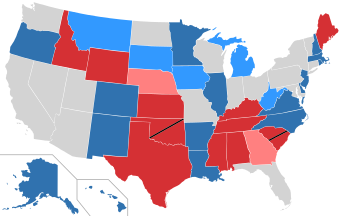
During the 2014 midterm election, all 435 seats in the U.S. House of Representatives and 33 seats in the U.S. Senate (including Senate races in eight Mississippi River states) will be contested. The election outcome will go a long way in determining how much political leverage the President has during the last two years of his second term.  Republicans need a net gain of six seats to realize control of the Senate, and it is likely that Republicans will maintain a majority in the House. Additionally, there will be numerous contests for governor and statehouse control across the country and River Basin (six Mississippi River states will hold gubernatorial elections).

Capitol Hill This Week - What to Watch For

Below are the two U.S. House and Senate hearings currently scheduled this week that relate to Mississippi River Basin water resources.  Most of the River Basin-related Congressional activity will be occurring occurring outside of the public view within three House-Senate conference committees, working, respectively, on the farm bill, Water Resources Development Act, and a Federal omnibus fiscal year 2014 spending bill.  For the two committee hearings, links are provided to the relevant Committee pages on the Internet. Many Congressional proceedings are webcast live, and these should be, as well (follow the appropriate link).  All times are Eastern.

Wednesday
Thursday

Friday, January 3, 2014

Mississippi River Basin Water Resource Weekly News

~Virtual Newspaper for an Aquatic World~

Noteworthy @UpperMiss Twitter Postings for the Week  

Water Quality -
  • NPR: How mass-produced meat turned phosphorus into pollution ow.ly/seYEg
  • Consultant and lobbyist says farmers need to be active in solving water quality concerns (North Dakota) ow.ly/sdk3S
  • Phosphorus standards for wastewater are cropping up in growing number of localities as standards become commonplace ow.ly/sdjJM
  • Ohio Environmental Protection Agency proposes limits on phosphorus and nitrogen amounts in state waterways ow.ly/sdjyq
Water Resource Management (Floodplains, Dams, Navigation, Wetlands, Flooding, Supplies, etc.) -
  • One thing Congress can agree on: Multimillion-dollar water projects ow.ly/sf1IO
  • New Orleans' Jefferson Parish local officials are urging several changes to FEMA flood maps ow.ly/sf1s5
  • The water is freezing earlier than usual this year on the upper Mississippi River, making navigation difficult ow.ly/sdgw7
  • Illinois River valley flooding tops the News Tribune (LaSalle, IL) list of significant 2013 news stories ow.ly/sdfSe
  • PBS Newshour: Can New Orleans' Lower Ninth Ward ever recover from Hurricane Katrina? ow.ly/sdeqx
  • Judge halts lawsuits seeking damages from federal government for Hurricane Katrina-related levee failures, flooding ow.ly/sdebf
  • Grand Tower, IL receives bad news on funding options for needed Mississippi River levee repairs ow.ly/sddvs
  • Federal budget deal failed to provide any clarity for operators overseeing Bureau of Reclamation water projects http://ow.ly/sfad7
Farm Bill-
  • GOP Congressman Steve King (IA): Farm Bill deal won’t necessarily be easy to strike in early 2014 ow.ly/scMu3
Agriculture -
  • Rents on prime US crop land expected to stay high in 2014 despite drop in grain prices, raising risk of income losses ow.ly/sdoBQ
  • US farmers becoming gripped by anxiety even as they close books on their best financial year ow.ly/sdmku
  • Corn is heading for the worst year since at least 1960 and wheat is poised for the biggest annual loss in five years ow.ly/sdiF8
  • Cover crops could help farmers improve soils, and the health of streams and rivers leading into the Gulf of Mexico ow.ly/sdhcv
December 31 U.S. Drought Monitor
Map (click to enlarge)
Climate and Weather -

Biodiversity, Wildlife and Invasives -

Endangered Species Act turns 40; critics say the law is costly, poorly administered and ineffective ow.ly/seYWi
Quad Cities area is a popular place for Bald Eagles, birdwatchers from December through February ow.ly/sdgQh


Louisiana Coastal Region-
  • LSU and federal government to study the worth of Gulf of Mexico monitoring systems in a three-year, $750,000 project ow.ly/sdgiF
Resource Development -
  • Operators of all oil and gas wells in Oklahoma must now report the chemicals used in hydraulic fracturing ow.ly/seZbG
  • New Food & Agricultural Policy Research Institute report: Renewable Fuel Standard Waiver Options for 2014 and Beyond ow.ly/sdiYZ
Federal Budget -
  • Congress is set to unveil a giant fiscal year 2014 spending bill next week ow.ly/scMzW
  • Omnibus FY 2014 spending bill takes shape as appropriations committees' staffs have worked through the holidays ow.ly/scMdY
Events -  Information on all past and future events listed here can be viewed in the on-line calendar (here as a stand-alone calendar)
  • 2014 Environmental Connection Conference (International Erosion Control Assn); Nashville, TN, February 25-28, 2014 ow.ly/seBpW
e-Newsletters, Publications, Journals, Multimedia  -
  • Minnesota Pollution Control Agency's Watershed Network News - December 26, 2013 ow.ly/sdo0o
  • Montana Watershed Coordination Council's December 27, 2013 Watershed News ow.ly/sdn1e
  • National Academies' Board on Agriculture and Natural Resources Winter newsletter ow.ly/sdi3O
Politics and People-
  • U.S. House Republicans have scheduled work on legislation next week aimed at easing environmental regulations ow.ly/seZmv
  • In Congress: battle lines are being drawn for a series of upcoming clashes over new regulations on horizon in 2014 ow.ly/sdmAM
  • Former Rep. Grassley staffer now will run for US House in Iowa’s 3rd Congressional District in 2014 instead of Senate ow.ly/seXTp
  • Field of Louisiana Republicans hoping to unseat Sen. Mary Landrieu (D-La.) in 2014 grows to three ow.ly/seC9R
  • GOP state Sen. Whitver will not seek the seat being vacated by longtime Rep. Tom Latham (R-Iowa-3) ow.ly/sdl8s
Last Word -
"The second week of January I would expect that we get a (farm) bill to the president."  - Iowa Sen. Chuck Grassley, speaking to reporters on Thursday about his hopes for passing a comprehensive farm bill in early 2014.