Wednesday, October 2, 2013

The Federal Debt Ceiling and What Reaching It Really Means


U.S. Department of the Treasury
On September 25, Treasury Secretary Jack Lew sent a letter to Congress with updated forecasts of the U.S. Treasury’s fiscal situation. According to his forecast, the Treasury will exhaust its borrowing capacity no later than October 17, at which time the Treasury Department will have exhausted its use of extraordinary measures (see below) to maintain a positive cash flow balance.

Lew requested that Congress immediately increase the debt limit in order to avoid reaching that borrowing capacity limit. On or about October 17, Lew reported, the Treasury would have only about $30 billion in cash balances on hand to meet existing federal obligations.  Government bills can total as much as $60 billion on any given day, so if the debt ceiling is not raised by the time the Treasury Department's extraordinary measures are exhausted, the government will be unable to pay its existing financial obligations (although, ironically, it would still be able to take on new obligations). This has never happened (i.e., the U.S. has never reached the point of defaulting on its financial obligations).

In the face of this upcoming deadline, this article provides an overview of and background on the debt ceiling issue.  Where applicable, respective U.S. Government Accountability Office (GAO), Congressional Research Service (CRS), and Congressional Budget Office (CBO) sources for the information provided.

Background
The debt limit is the amount of money that the federal government is authorized to borrow to meet its existing financial obligations, such as Social Security and Medicare benefits, military salaries, interest on the national debt, tax refunds and other payments. The debt limit simply allows the government to finance existing legal obligations made in the past [Source: U.S. Treasury Department].

The U.S. Congress has always restricted the amount of federal debt that the government can incur. The Second Liberty Bond Act of 1917 included a limit on federal debt as well as limits on specific debt categories.  During the 1920s and 1930s, Congress altered those restrictions to give the U.S. Treasury more debt management flexibility, and in 1939, a general limit was placed on the size of the federal debt.  When the federal debt approaches or is at that debt limit, Congress needs to increase the limit before it can be exceeded.  

Increasing that debt limit frequently involves lengthy debate by Congress. And when such delays occur, the Treasury Department has to depart from normal cash and debt management operations to avoid exceeding the debt limit; employing what are called "extraordinary measures" [Source: GAO].  

Extraordinary Measures
When needed to maintain a positive cash flow, the Treasury can employ alternative strategies for managing its cash and borrowing in order to continue funding government activities. Treasury has a well-established toolbox of so-called "extraordinary measures" that will make continued borrowing possible for a limited time if the current debt limit is reached. Specifically, the Treasury can take the following steps:
  • Suspend the investments of the Thrift Savings Plan G Fund (otherwise rolled over [or reinvested] daily)
  • Suspend the investments of the Exchange Stabilization Fund (otherwise rolled over daily)
  • Suspend the issuance of new securities to the Civil Service Retirement and Disability Fund and Postal Service Retiree Health Benefits Fund
  • Redeem a limited amount of Civil Service Retirement and Disability Fund securities and Postal Service Retiree Health Benefits Fund securities early
  • Suspend the issuance of new State and Local Government Series (SLGS) securities and savings bonds (typically between $3 billion and $12 billion in SLGS securities and less than $1 billion in savings bonds are issued each month); and
  • Replace Treasury securities subject to the debt limit with debt issued by the Federal Financing Bank, which is not subject to the limit (up to $8 billion).
Those measures provide the Treasury with additional room to borrow by limiting the amount of debt held by the public or debt held by government accounts that would otherwise be outstanding [Source: CBO]. For example, in 2011, Treasury Secretary Geithner invoked authority to use extraordinary measures on May 16, 2011, which helped fund payments until the debt ceiling was raised on August 2, 2011. [Source: CRS].

Tuesday, October 1, 2013

Impacts of the Government Shutdown on Federal Agencies with a Mississippi River Basin Connection

Below is a summary of Federal agency impacts expected because of the government shutdown, compiled by the Northeast-Midwest Institute's Great Lakes Washington Program Director, Danielle Chesky. Links to information sources are provided for each agency.

Environmental Protection Agency (EPA)
Approximately 94% of EPA’s 16,204 employees are expected to be furloughed starting today. Oversight of some Superfund sites may qualify for an exception to remain staffed, ensuring the site does not pose an imminent threat to public health. About 300 of the 800 superfund sites were determined to qualify for the exception. Huffington Post

US Fish and Wildlife Service (USFWS)
A total of 1,794 USFWS employees will be exempt from the federal shutdown furloughs, serving in law enforcement, animal caretaker, and emergency personnel departments, among others. Fish hatcheries are included under the animal caretaker portfolio. Department of Interior Contingency Plan

US Geological Survey (USGS)
Only 43 of USGS’ 8,623 employees have been designated as exempt and will remain on the job, according to the Department of the Interior’s Contingency Plan for the U.S. Geological Survey. Designated essential activities include the National Earthquake Information Center and the Earth Resources Observation and Science Center. Of those furloughed, 200 employees will be on call and ready to be exempted should a natural disaster occur.

National Oceanic and Atmospheric Administration (NOAA)
About 45% of NOAA employees are expected to be furloughed beginning today. Most workers remaining on the job are with the National Weather Service. Fishery Nation

Army Corps of Engineers
Mississippi River locks and dams, as well as other commercial traffic and flood control aspects, will remain open as they are considered core functions. Recreation areas are expected to close. Projects funded through prior year appropriations, like for Hurricane Sandy impacts, will continue. NBC St. Paul-Minneapolis

Monday, September 30, 2013

Capitol Hill This Week - What to Watch For (Maybe)

While the clock ticks down to a possible October 1 Federal government shutdown, below are the more "routine" U.S. House and Senate activities currently scheduled for the week that relate to Mississippi River Basin natural resources.

Keep in mind that a shutdown will likely impact this schedule. Although members of Congress will continue to be paid, even in the event of a shutdown, their congressional staffers may not get paid without specific appropriations.  Also, some of the hearing witnesses may be Federal agency employees who could be shutdown-impacted.  The House Energy and Commerce and the Science, Space and Technology Committees, for example, have already announced that they will cancel scheduled hearings for this week if Congress is unable to reach a deal tonight to avert a government shutdown.

Where available, links are provided to the relevant Committee and legislation pages on the Internet. Many of the proceedings are webcast live (follow the appropriate link).  All times are Eastern.

Tuesday
Wednesday
Thursday

Friday, September 27, 2013

Mississippi River Basin Water Resource News of the Week


~Virtual Newspaper for an Aquatic World~

Capitol Hill Next Week - What to Watch For
While the clock ticks down toward a possible October 1 federal government shutdown (see below, under "Federal Budget"), there are some more routine U.S. House and Senate activities scheduled next week that relate to Mississippi River Basin natural resources.  We count about a half dozen or so such hearings, and here is a link to those events.

Farm Bill Inches Forward
On Thursday evening (September 26), the House Rules Committee cleared the way for a House procedural floor vote as early as Friday (but possibly next week) to combine the pared down farm bill it passed in July with a missing nutrition title passed on September 19. Following passage of that motion, the House will send the combined farm bill package to the Senate, setting the stage for the formation of a conference committee made of House and Senate members, tasked to work out the differences between the competing bill versions. That whole process, under the best of conditions, is time-consuming, and portions of the current farm bill will expire at the end of this month.  For more details, see the articles below under "Farm Bill" and our updated farm bill news and resource page.


USGS Chemical Prioritization Approach Toward Ambient Water and Sediment Quality Monitoring Focuses on Human and Aquatic Health
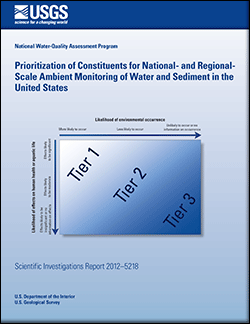
The USGS National Water-Quality Assessment (NAWQA) Program has released a revised September 2013 update to an earlier report addressing the prioritization of constituents to be assessed when evaluating water and sediment quality. Entitled, "Prioritization of Constituents for National and Regional Scale Ambient Monitoring of Water and Sediment in the United States," the report describes a tiered prioritization approach that can be used by water resource managers when selecting chemicals to be included in ambient water and sediment quality monitoring strategies. Over 2,500 chemicals were prioritized by a NAWQA National Target Analyte Strategy Work Group based on physical and chemical properties, observed and predicted environmental occurrence and fate, and observed or anticipated adverse health or environmental effects. 1,081 of the constituents evaluated were determined to be of highest priority for ambient monitoring.

Notable @UpperMiss Twitter Postings for the Week

Water Quality -
Chesapeake Bay Nutrient TMDL Ruling
  • How EPA will apply Federal Court's Chesapeake Bay clean water precedent in other multi-state water bodies is unclear http://ow.ly/p7w1W
  • American Farm Bureau Federation will appeal court Chesapeake Bay ruling backing EPA's nonpoint water pollution limits In TMDLs http://ow.ly/p9I5q
  • In Clean Water Act nutrient ruling, court gave "due deference" to EPA’s scientific and technical expertise; not to alleged coercion http://ow.ly/p7mWD
Ruling on EPA Rejection of 2008 Environmental Groups' Petition
  • InsideEPA News: Judge orders EPA to determine adequacy of Mississippi River watershed nutrient limits approach  http://ow.ly/p9HRz
  • DTN: Court says EPA must provide more detailed defense for letting states take water-quality lead in Mississippi River basin http://ow.ly/p9HF2
  • Court says EPA must fully respond to environmental groups’ Mississippi River Basin water quality rulemaking petition: NRDC blog article: http://ow.ly/p8oVu; court ruling (PDF file): http://ow.ly/p8oxy
  • Huffington Post: Mississippi River Pollution Standards Ruling Tilts In Favor Of Environmental Advocates http://ow.ly/pdyFJ
  • Regional news coverage of court ruling on EPA Mississippi River Basin nutrient management approach http://ow.ly/p9IkZ http://ow.ly/p9IqX http://ow.ly/p9It1 and http://ow.ly/p9Imu
  • EPA proposal for preempting state water quality standards could stymie lawsuit over Mississippi Basin nutrient limits http://ow.ly/p3Uzw (article published before court ruling)
Gulf Hypoxia
  • Huffington Post: "We Are Quickly Turning the Ocean into a 'Dead Zone'" http://ow.ly/p3WPb
  • September Gulf Hypoxia Task Force report highlights progress; recommends accelerated nutrient reduction efforts http://ow.ly/pbQdb
  • Gulf Hypoxia Task Force: Efforts to significantly shrink size of Gulf of Mexico's dead zone will fall short http://ow.ly/pc11e
  • MPR News: The Upper Mississippi River 1926 dead zone holds lessons for Gulf of Mexico today http://ow.ly/pcybe
  • EPA: Goal to reduce Gulf 'dead zone' won't be met by 2015 http://ow.ly/pc1H6
  • Minnesota "taking lead" to cut size of Gulf of Mexico ‘dead zone’ http://ow.ly/peh9m
Other Water Quality News
  • Wetlands: Battle lines form as EPA hints at revised Clean Water Act jurisdiction regulatory plan http://ow.ly/pcz3k
  • Industry fears that an EPA waters of the U.S. study opens the door to blanket scrutiny of smaller waterbodies http://ow.ly/pgCjQ
  • State regulators around US consider using controversial "probabilistic" risk assessment method for setting water quality criteria http://ow.ly/pegqi
  • National Wildlife Federation report: "Toxic Algae: Coming Soon to a Lake Near You?" highlights summer algal blooms http://ow.ly/pc0lW (E&E article on report: http://ow.ly/pc0zL
  • St. Charles Parish, Louisiana residents can report pollution to interactive "iWitness Pollution" map http://ow.ly/p7zXj
  • USGS, state agencies sample flood-swollen South Platte River in Colorado and Nebraska for contaminants http://ow.ly/p7Awx
  • EPA has released an enhanced version of the BASINS nonpoint water pollution source software tool http://ow.ly/p9Gim
  • MPCA drafts plan to reduce Twin Cities (MN) metro lakes' and stream pollution http://ow.ly/p9Yxf
  • Hundreds of fish die in Spoon River in western Illinois, possibly from corn syrup spill http://ow.ly/pc0Mt
  • Minnesota sets nutrient water quality goals; Environmental groups say they are admirable but will need more enforcement http://ow.ly/pc2fU
  • WI Public Radio: Wisconsin says it has reduced fertilizer runoff into surface waters; others: but it has to do more http://ow.ly/pgD0t
  • Wisconsin factory farm to pay $100,000 settlement to state for water pollution, wetland damage, air emissions  http://ow.ly/pefOD
Water Resource Management (Floodplains, Dams, Navigation, Wetlands, Flooding, Supplies, etc.) -
  • St. Louis Post-Dispatch editorial: Combination of Army Corps and Congress has failed America's great rivers http://ow.ly/p7s2M
  • Ohio Valley Environmental Coalition rallies against transfer of fracking waste water on Ohio River barges http://ow.ly/p9Y7L
  • Missouri Gov. Nixon urges Corps to put hold on Missouri River endangered fish habitat project http://ow.ly/pc1Vu and http://ow.ly/pc1Y9
  • Fearing that Congress may reverse decision to raise flood insurance rates, advocates press for homeowner rate aid http://ow.ly/pc7ZR
  • Appraisals begin on Mississippi River 2011 flood-damaged property buyouts in Illinois http://ow.ly/pehly
  • Lawsuit dismissed that challenged Nebraska-approved plan to pump groundwater into streams http://ow.ly/peg8K
  • Missouri River in Bismarck, ND drops 2.8 feet in two weeks http://ow.ly/pei2k
  • Barge industry group suggests 6 to 9-cent increase to 20-cent/gal barge fuel tax paid to fund water resource projects http://ow.ly/pgNXt
Farm Bill-(Here is our latest 2013 Farm Bill News and Resources update (UPDATED September 27) ow.ly/pgIZa)
  • House Rules Committee sets up farm bill floor vote to combine separate titles approved in July and last week http://ow.ly/pgEw3
  • House leaders may yet move this week to appoint farm bill conferees, once dual farm and food efforts are merged http://ow.ly/peiq1
  • Shutdown or Not, Farm Bill Extension Expires on October 1 http://ow.ly/pcU9Q 
  • With time running short, House leaders work with Senate counterparts toward a new five-year farm bill http://ow.ly/pbTvL
  • Uncertainty envelops three of the month's Congressional debates: government funding, the debt ceiling and a farm bill http://ow.ly/pbU7q
  • Farm bill fate in Congress is as unclear as it ever has been http://ow.ly/p7j4P
  • Choice Magazine op-ed: "Ten Considerations Regarding the Role of Crop Insurance in the Agricultural Safety Net" http://ow.ly/p7kbJ
Agriculture -
  • USDA assembles over 75 charts and maps of key U.S. farm, food sector information, including land, water and other natural resources http://ow.ly/p7I0a 
  • Ranchers and farmers are increasingly opting out of federal Conservation Reserve Program to reap high crop profits http://ow.ly/p7jJ8
  • Iowa farmland values are beginning to show signs of softening http://ow.ly/p7kzG
  • Urban Agriculture: Programs and Policy in Minnesota http://ow.ly/pc6f0
  • Despite late-season drought in Quad-City area and Corn Belt states, farmers are awed and surprised by the corn yields http://ow.ly/pgIAT
Biodiversity, Wildlife and Invasives -
  • National Marine Fisheries Service to determine if Alabama shad should be protected under Endangered Species Act http://ow.ly/p3VN2
  • Grand Forks Herald editorial: Asian carp threaten Minnesota's economy, culture http://ow.ly/p7qAr
  • Government and fishing industry officials push for Peoria, IL Asian carp processing plant http://ow.ly/pehT7
  • Landowners along 130-mile Missouri River stretch may aid in conservation to protect 140,000 acres of fragile habitat http://ow.ly/p7sTW
  • The grotto sculpin, a rare fish found in Missouri, has been granted Federal endangered species status http://ow.ly/pd3pB
  • Report: A review of Keystone XL pipeline earlier this year underestimates its effects on vulnerable species http://ow.ly/pej0p
Climate and Weather -
  • NOAA drought report: Midwestern mix of drought improvement, deterioration; substantial Plains drought reductions ow.ly/peM85
  • Coming soon: A new version of the U.S. Drought Monitor website; example layout: http://ow.ly/pdJpU
  • UN climate science panel: global warming “unequivocal” with at least 95 % chance human activities are its main driver http://ow.ly/pgE4z
In the Cities -
  • Illinois awards Sterling a $1.3 million grant to revitalize Rock River riverfront and add green infrastructure http://ow.ly/p7Fat
  • Upper Mississippi River and Urban Waterfronts 2013 Joint Conference will focus interest on Davenport, IA riverfront http://ow.ly/pc2D7
Resource Extraction -
  • Small MN and WI government entities line up in support of silica sand mining ban along Mississippi River http://ow.ly/pehDA
Federal Budget -
  • Senate to vote on stop-gap funding bill today (Friday), leaving House Speaker Boehner tough choices http://ow.ly/pgDPd
  • Washington Post: “Everything you need to know about how a government shutdown works” http://ow.ly/peiFD
  • House Republicans plan to insert debt ceiling bill provisions to limit EPA regulations http://ow.ly/p7nTy (Also see: House GOP prepares wish list for debt-limit legislation http://ow.ly/p7ovI)
Events -  Information on all past and future events listed here can be viewed in the on-line calendar (here as a stand-alone calendar)
  • Free October 9 National Urban Flooding Forum at WEFTEC 2013, Chicago, IL; register by September 27 http://ow.ly/pbNec
  • EPA Watershed Academy Webcast on new “National Stormwater Calculator”  Oct. 2, 2013 from 1-2:30 pm ET http://ow.ly/p7lCb
  • National Park Service at St. Croix National Scenic Riverway will host Autumn Fest on Oct. 5, St. Croix Falls, WI http://ow.ly/p7rbS
  • Economic and Ecological Benefits of Agricultural Conservation Systems panel; Oct. 21, 3:30 PM; Washington, DC http://ow.ly/pdxAu  RSVP here: http://ow.ly/pdxUy
  • November 20-21:   2013 Green Lands Blue Waters Conference, Minneapolis, MN. Save the date. http://ow.ly/pbOho
  • Upper Midwest Stream Restoration Symposium; February 23-26, 2014 at the Radisson in La Crosse, WI ow.ly/pf9yO
e-Newsletters, Publications and Journals -
  • Green Lands Blue Waters bi-weekly update on efforts to promote continuous living cover on Mississippi River Basin agricultural land http://ow.ly/pbO3T
  • The Horinko Group Newsletter: September 2013 with a heavy water resource focus this month http://ow.ly/pbP4j
  • Association of State Floodplain Managers "News and Views" August 2013 http://ow.ly/pcUVD
  • Montana Watershed Coordination Council "Watershed News" http://ow.ly/pgKDH
Other news-
  • A Case for an Incremental Adaptive Management Approach to Ecosystem Restoration and Resiliency - Moving from Compliance-Driven Outputs to Stewardship-Driven Outcomes in the Mississippi River Basin http://ow.ly/pbPtq
  • Community college consortium receives Dept. of Labor grant funding to advance Mississippi River region economic development http://ow.ly/p47Oq
  • Work is rolling on the Mad River (Ohio) recreational "River Run" whitewater project http://ow.ly/p7ssX
  • Rep. Fred Upton (R-MI) to pressure biofuels sector to support a legislative fix to EPA's renewable fuel standard http://ow.ly/pbZI5
  • $1.2 million contract awarded for construction of Mississippi River Trail between Anoka and Ramsey, MN http://ow.ly/pgDvC
Political Scene -
  • Change in leadership of Army Corps of Engineers' Mississippi Valley Division becomes official September 24 http://ow.ly/p7v1V
  • Sen. Mary Landrieu (D-LA) campaigning to be next top Democrat on Senate Energy and Natural Resources Committee http://ow.ly/pc7vN
  • Sen. Chuck Grassley (R-IA) says in television interview that he intends to seek a seventh Senate term in 2016 ow.ly/p7hpy
  • Ed Marksberry is leaving the Kentucky U.S. Senate Democratic primary to run as an independent http://bit.ly/1fe51z7
  • The most urgent question for the GOP in Mississippi is whether Sen. Thad Cochran will retire in 2014 ow.ly/peoJ9
  • Transportation and Infrastructure Chair Shuster's (PA) GOP primary challenger argues Shuster isn't conservative enough http://ow.ly/pgNxR
Last Word
Gene Kelly Singing Happily in "Singin' in the Rain" (1952)
The third thing the Corps of Engineers cannot do is make everybody happy, and I’m beginning to think we can’t make anybody happy.” - John Paul Woodley, former Assistant Secretary of the Army, in a 2005 interview with the St. Louis Post-Dispatch for his book “Big Muddy Blues.”  The other two things, according to Woodley, are, first, making it rain, and, second making the rain stop.  (Ed. note: Perhaps we should all take Gene Kelly's approach to the rain)

Friday, September 20, 2013

New Tiered Chemical Prioritization Approach for Ambient Water and Sediment Quality Monitoring Focuses on Human and Aquatic Health

The USGS National Water-Quality Assessment (NAWQA) Program has released a revised September 2013 update to an earlier report addressing the prioritization of constituents to be assessed when evaluating water and sediment quality.  Entitled, "Prioritization of Constituents for National and Regional Scale Ambient Monitoring of Water and Sediment in the United States,"  the report describes a tiered prioritization approach that can be used by water resource managers when selecting chemicals to be included in ambient water and sediment quality monitoring strategies. Over 2,500 chemicals were prioritized by a NAWQA National Target Analyte Strategy Work Group based on physical and chemical properties, observed and predicted environmental occurrence and fate, and observed or anticipated adverse health or environmental effects.  1,081 of the constituents evaluated were determined to be of highest priority for ambient monitoring.

The constituents prioritized for this effort included various types of organic compounds, trace elements and other inorganic constituents, and radionuclides, and were placed into three tiers:
Tier 1: those having the highest priority on the basis of their likelihood of environmental occurrence in ambient water or sediment, or likelihood of effects on human health or aquatic life;
Tier 2: those of intermediate priority on the basis of their lower likelihood of environmental occurrence or lower likelihood of effects on human health or aquatic life; and
Tier 3: those with low or no priority for monitoring.

This effort was undertaken in preparation for the upcoming third decade of the NAWQA Program (2013-2023).

Mississippi River Basin Water Resource News of the Week

~Virtual Newspaper for an Aquatic World~

This Week and Next in Congress
Farm bill - The nutrition section of the farm bill that the House trimmed from its version of the farm bill back in July was passed by that chamber yesterday (September 19), setting the stage for a conference committee to negotiate the full farm bill with the Senate "as soon as we can," according to House Speaker John Boehner (R-OH).   Stay tuned.  And if you're interested in all of the gory details, you can click this link to read more.


Water infrastructure - Also on September 19, the House Transportation and Infrastructure Committee passed its Water Resources Reform and Development Act (H.R. 3080), a major water resources authorization bill, on a voice vote, setting up its consideration sometime this fall by the full House.   Here are the details of that bill, and of the companion Senate bill, presented from a Mississippi River Basin perspective.

Next week - There are not many River Basin-related Congressional hearings or meetings of note to point to next week, since the House had been scheduled for a week's recess; however, House Majority Leader Eric Cantor earlier this week said that the House would reconvene next Wednesday (September 25) for legislative business centered on the upcoming September 30 end to the fiscal year and need to pass a continuing resolution. The House will likely vote on its continuing resolution today (Friday), and send it on to the Senate.   Senate leaders believe they have devised a way to move the bill without forcing GOP conservatives to vote against defunding Obamacare.  The Senate is adjourned until Monday, when it is likely to place the continuing resolution on next week's Senate calendar.  In other words, the situation is "fluid."  Stay tuned.

Notable @UpperMiss Twitter Postings for the Week  

Water Quality -
Clean Water Act Jurisdiction
  • Agencies release draft Clean Water Act jurisdiction plan but drop plans for a related interim guidance ow.ly/oYO4e
  • Army Corps considering utilizing a new, uniform method for determining the limits of Clean Water Act's jurisdiction ow.ly/oYOgn
Other Water Quality News
  • New USGS tiered water and sediment quality monitoring chemical prioritization approach focuses on human and aquatic health http://ow.ly/p3gAN
  • District Court judge's EPA nutrient standards' ruling has implications for Midwestern farmers and ag retailers http://ow.ly/p1pt7
  • Center for Neighborhood Technology's urban flood study may help EPA assess stormwater rule benefits http://bit.ly/15XN0Br
  • Farm groups: environmental groups made "false accusations" when asking court to intervene in CAFO information lawsuit http://ow.ly/oU5GC
  • Kentucky circuit court judge sides with environmental groups over local power plant in clean water lawsuit ruling http://ow.ly/oU66G
  • Centers for Disease Control and Prevention confirms St. Bernard Parish water system tests positive for rare amoeba http://ow.ly/oUvy3
  • Industry likely to appeal court ruling favoring EPA discretion to set nonpoint, point water pollution allocations http://ow.ly/oUzgD
  • Wisconsin’s draft Nutrient Reduction Strategy calls for putting no new pollution-control regulations into effect ow.ly/oYMku
  • Talks between EPA and environmental group collapse over Federal stormwater rule revision deadline http://ow.ly/p0Zdp
  • Obama Administration urged to issue new fish consumption advisory before signing global mercury pact http://ow.ly/p0ZIV
  • Judge: Indiana failed to fully assess the impact of coal waste runoff on local waterways in issuing permit http://ow.ly/p1loi
Water Resource Management (Floodplains, Dams, Navigation, Wetlands, Flooding, Supplies, etc.) -
  • House Committee passes water infrastructure bill http://ow.ly/p39Pl and http://ow.ly/p3aiX (link to bill: http://ow.ly/p3alD)
  • Rep. Noem (R-SD) supports House bill provision requiring Corps of Engineers to communicate Missouri River flood risks http://ow.ly/oUCC8
  • U.S. Chamber of Commerce calls on Congress to quickly pass new bill to boost American ports and waterways http://ow.ly/p0Uaw
  • Committee-passed House water bill would close Mississippi River lock in Minneapolis to block Asian carp http://ow.ly/p3mcz
  • Olmsted Locks and Dam work costing billions more than expected as delays mount http://ow.ly/oUxeP
  • Army Corps better prepared for Mississippi River low water situation this fall and winter after 2012 drought http://ow.ly/oUBjV
  • Army Corps says low water levels may affect Mississippi River industries http://ow.ly/p3mE0
  • Op-ed: "Missouri River water plan ignores state and tribal rights" http://ow.ly/oUC9o
  • Resources for the Future: "The National Flood Insurance Program: Directions for Reform" http://ow.ly/oWogi
  • Lawmakers criticize FEMA for not doing more to help homeowners avoid looming flood insurance price increases http://ow.ly/p11yI
  • Senators propose to revamp Harbor Maintenance Trust fund through new "Maritime Goods Movement Act" bit.ly/155OOSM
  • Army Corps undertaking $ millions worth of repair to Missouri River's Gavins Point Dam bit.ly/16eGxv8
  • Southeast Arkansas study to investigate problems threatening navigation, aquatic ecosystem habitat bit.ly/16lB4Up
  • Maritime Administration designates Missouri River from Kansas City, Missouri to Sioux City, Iowa, as a Marine Highway bit.ly/1a3GZR2
  • Plaquemines Parish proposed coal terminal's permit is protested by environmental groups http://ow.ly/p1kF8
Farm Bill-
  • Farm bill continues to move along with passage of House food stamps cuts, but exactly where it's moving to is unclear http://ow.ly/p3e9s
  • House passes a bill to fund nutrition programs as part of a farm bill; cuts SNAP by $40 Billion over 10 years http://ow.ly/p375a
  • Farm bill fight is back: pitting one region against another; creating its own set of refugees http://ow.ly/oUuzc
  • R Street Institute seeks help from nation's hunters and anglers on farm bill insurance-conservation linkage measure http://ow.ly/oWpQv
  • Over 100 House members urge House leaders to link conservation and farm subsidies in the farm bill http://ow.ly/p10rb
  • "Five choice nuggets contained in the Nutrition Reform and Work Opportunity Act of 2013"  ow.ly/oYM85
  • Des Moines Register editorial board blasts GOP SNAP (food nutrition) cuts ow.ly/oYNmX
Agriculture -
  • Biofuels advocates argue that 2013's "huge" corn crop weakens legitimacy of calls for Renewable Fuel Standard repeal ow.ly/oYOqg
  • EPA intends to "vigorously defend" itself against farm groups' Freedom of Information Act lawsuit allegations bit.ly/19ehv0X
  • World’s largest agri-chemicals company to call on farmers to use less pesticide, fertilizer to grow more crops http://ow.ly/p39b5
  • Hancock County, Iowa, cattle feeder agrees to "innovative settlement" for violating water permit http://ow.ly/p3d7D
September 17 Drought Monitor Map
Climate and Weather -
  • Last week brought some drought relief but drought expanded in some Midwestern and southern states (SD, IL, IN, MO, AR, LA, MS) http://ow.ly/p1gZs
  • Scientists outline possible farming adaptations in response to climate change bit.ly/16egWDx
Biodiversity, Wildlife and Invasives -
  • "Jurassic Carp" - Asian carp are adapting to river conditions in Indiana in alarming ways http://ow.ly/p3cFC
  • Op-ed by Army Corps: Asian carp threat has its limits; not helpful for media to be ambiguous on northern fish range http://ow.ly/oWqGl
  • Environmental DNA (or eDNA) emerges as key tool in the battle to stop the spread of Asian carp http://ow.ly/p10Jc
  • Stakeholders divided on whether Asian carp test results signal strong threat requiring aggressive, expensive response http://ow.ly/p12ZK
  • Rule issued resolving long-standing dispute regarding how economic impacts of critical habitat designation should be analyzed http://ow.ly/p1i4G
In the Cities -
  • Mississippi River levee bike and pedestrian path in Algiers, La. expected to advance this week http://ow.ly/oUASf
  • Ascension Parish eyes low-interest loan to build regional sewer system http://ow.ly/p1kWu
In the States-
  • New Association of Clean Water Agencies president: EPA should reconsider states' obligations in light of budget cuts http://bit.ly/14S3CV2
  • State water regulators urge EPA to consider their smaller budgets in assessing state enforcement, permitting adequacy http://bit.ly/162Cime
Louisiana Coastal Region-
  • Mid-Barataria project could be first of 10 in Louisiana aimed at reinforcing eroding coast http://ow.ly/p12bz
  • Louisiana could begin building Mid-Barataria sediment diversion by late 2015 http://ow.ly/p1jMy
  • "Changing Course" competition aims to rescue wetlands around Mississippi River from sinking into Gulf of Mexico http://ow.ly/p12Ej
  • Coastal authority urges longer version of West Shore Lake Pontchartrain levee http://ow.ly/p1kou
Resource Extraction -
  • West Virginia Department of Environmental Protection Secretary says state drilling/fracking regulations are sound http://ow.ly/oQAY2
  • West Virginia University research findings suggest that surface landowners need increased rights in drilling boom http://bit.ly/1aw7wY7
  • Model zoning standards for Minnesota’s frac-sand mining industry criticized by foes http://ow.ly/p1jrF
Federal Budget -
  • Forget the Federal government shutdown, the debt limit hike is real problem http://ow.ly/p0UxU
  • House poised to pass continuing resolution, pushed by Republican leaders at the behest of conservatives http://ow.ly/p39tb
  • Senators identify bill strategy to fund federal government without forcing GOP to vote against defunding ObamaCare http://ow.ly/p39Dd
  • As the end of the Fiscal Year looms, GOP leaders rework budget Continuing Resolution in a bow to party conservatives ow.ly/oYNOT
  • House cancels next week's scheduled recess and will return Sept. 25 to address government spending bill http://ow.ly/p0TwY
Events -  Information on all past and future events listed here can be viewed in the on-line calendar (here as a stand-alone calendar)
  • Association of State Floodplain Managers 2014 Annual Conference call for presentations now open http://ow.ly/oTURR
  • NC-FAR Capitol Hill Research Seminar: Did a cow just eat my dinner? Washington, DC; Sept. 23; presented twice http://ow.ly/oUsd8
  • Webinar: Valuing Green Infrastructure: Economic, Environmental, and Social Benefits, September 26, 2:30 - 3:30 PM ET http://ow.ly/oUtdw
  • USACE course: Monitoring Wisconsin Streams for Sediment; September 25 – 26, University of Wisconsin-Green Bay ow.ly/oYMzG
  • 2013 Groundwater Expo and Annual Meeting in Nashville, Tennessee, December 3-6 ow.ly/oYMJI
  • River Rally 2014; hosted by River Network and Waterkeeper Alliance; May 30 – June 2; Pittsburgh, PA ow.ly/oYMUb
  • National CAFO Roundtable on October 15-17 in Sacramento, CA, agenda: http://ow.ly/p0W6u register: http://ow.ly/p0W8Z
  • Oklahoma Scenic Rivers Commission to host workshops, fundraisers http://ow.ly/p3n5T
e-Newsletters, Publications and Journals -
  • Aquatic Sciences Chronicle, Volume 3, 2013 (U of WI Water Resources Institute and Sea Grant Institute) http://ow.ly/oQAJ4
  • America's Waterway River Currents Newsletter - September http://ow.ly/oWnDx
  • Resources for the Future's September Resources Magazine http://ow.ly/oWoqM (PDF here: http://ow.ly/oWos8)
  • Pennsylvania Environmental Council's Fall "Forum" newsletter bit.ly/15CzbGj
  • Minnesota Pollution Control Agency's Watershed Network News - Sept. 18 bit.ly/1doPdFc
  • Link to the September 18 "Water News and More" from the Tulane Institute on Water Resources Law and Policy here http://ow.ly/p0WUB
  • American Farmland Trust September E-News: about Farmland Stewardship and the Farm Bill http://ow.ly/p36rw
  • Montana Watershed Coordination Council's Watershed News September 19 http://ow.ly/p3cfO
Other news-
  • Two overlapping Mississippi River/water conferences: Mississippi River has problems, potential bit.ly/1ePF9t0
  • Pete Montalbano, Army Corps levee safety program manager, Mississippi Valley Division, retires after 31 years http://ow.ly/oUBFx
  • Frontiers in Ecology and the Environment article on the role of psychology in conservation http://ow.ly/oUsEX
  • Eclectic group forms Iowa River Friends to foster enjoyment and improvement of the River http://ow.ly/oWqjI
  • Great River Road, from Minnesota to Gulf of Mexico, to turn 75; St. Louis celebration planned http://ow.ly/p12qI
Political Scene -
  • Senate committee shows bipartisan support for Michael Connor to become new Interior Department deputy secretary ow.ly/oYODz
  • Agriculture Secretary Vilsack taps former congressional staffer to be his next chief of staff http://ow.ly/p114w
  • Louisiana Governor won’t reappoint two regional levee officials who supported wetland damages lawsuit http://ow.ly/oUw5D
  • West Virginia Secretary of State Natalie Tennant (D) expected to announce US Senate campaign soon http://ow.ly/oTXlj
  • Bill Daley exits Illinois 2014 governor's Democratic primary race http://ow.ly/oWntn
  • Two high-profile Iowa Republicans actively exploring bids for US Senate seat being vacated by Sen. Tom Harkin (D-IA) http://ow.ly/oWrE7
Last Word -
Sen. Tim Kaine (D-VA)
"nonpareil" - The word that Sen. Tim Kaine (D-VA) spelled correctly Wednesday night to claim his prize as the winner of the Politicians vs. Press Spelling Bee at the National Press Club.  The word means, "having no match or equal; unrivaled."

Monday, September 16, 2013

House Water Resources Bill Passes Out of Committee

On September 19, the House Transportation and Infrastructure Committee passed its Water Resources Reform and Development Act (H.R. 3080), a major water resources authorization bill, on a voice vote, setting up its consideration sometime this fall by the full House.  Here is a Section-by-Section overview of the House bill (known as "WRRDA"), provided by the Transportation and Infrastructure Committee (PDF file).  The Committee WRRDA web page additionally provides a "Whiteboard Video explains our new bill," along with links to the bill text and a Committee information package.

Based upon indications contained in a legislative priorities' memo from House Leader Eric Cantor to GOP members earlier in September, the bill should be voted on by the full House sometime this autumn.  The Senate version of the bill, the "Water Resources Development Act of 2013," was passed in May by a 83-14 vote.  Assuming WRRDA passes the House, the two bills would likely head to a Senate-House conference committee, during which conferees would attempt to reconcile their differences. Here is an analysis of the Senate bill, particularly as it relates to Mississippi River Basin water issues.

While authorizing 23 navigation, flood protection and ecosystem restoration projects, WRRDA also establishes a new procedural mechanism to approve new, future projects, and proposes to reform existing Army Corps of Engineers' procedures, by arguably streamlining the project review process and capping the cost of project studies.  In addition to those and other sections of the bill of a more national scope, the House draft measure contains several provisions that directly reference and would impact Mississippi River Basin and Gulf Coast waters. Here are several such provisions of note:

Section 116 of the bill requires the Corps of Engineers, as part of the President's annual budget process, to report to Congress on the prioritization of federal actions to be carried out during the next fiscal year to mitigate for fish and wildlife losses as a result of Corps of Engineers projects in the Missouri River Basin. The wording calls for the Corps' report to "assist in the prioritization of Federal activities" related to a Missouri River Bank Stabilization and Navigation Project designed to  repair channel stabilization structures on the Missouri River as a result of damage sustained during the flood of 2011 (in Missouri, Kansas, Iowa, and Nebraska).   The report to Congress is to include:
  1. " an inventory of all Federal actions taken and a prioritization of all Federal actions planned in furtherance of the project, including an inventory of lands owned, acquired, or directly controlled by the Federal Government, and lands enrolled in federally-assisted conservation programs; 
  2. "a description of the specific Federal actions proposed for the upcoming fiscal year in furtherance of the project; 
  3. "an assessment of the progress made in furtherance of the project, including a description of how each of the actions identified under paragraph (1) have impacted such progress; and 
  4. "an assessment of additional actions necessary to achieve the results of the project."
Upper St. Anthony Falls Lock and Dam
Section 219 would require the Army Corps of Engineers to complete a study of and submit a report to Congress on the impact on the economy and environment of closing the Upper St. Anthony Falls Lock and Dam (on the Mississippi River in Minneapolis, MN).  Closure of that Lock and Dam has been proposed as a means to lower the probability of invasive and damaging Asian carp from moving farther upriver.  The bill would require mandatory closure of the Lock and Dam if "the annual average (barge navigation goods) tonnage moving through the Upper St. Anthony Falls Lock and Dam during the preceding 5 years was not more than 1,500,000 tons."

The Lucas-Berg Pit confined disposal facility in Illinois would be one of 15 Army Corps' projects deauthorized by the bill in Section 304.  That project is described by the bill as the "portion of the project for navigation, Illinois Waterway and Grand Calumet River, Illinois, authorized by the first section of the Act entitled 'An Act authorizing the construction of certain public works on rivers and harbors for flood control, and for other purposes'").  The navigation channel in question (in conjunction with the Chicago Sanitary and Ship Canal) connects Lake Michigan with the Illinois Waterway system.

Projects described in six Army Corps' Mississippi River Basin or Gulf Coast feasibility studies are authorized  for construction under Section 401 of the bill.  They include three flood risk management projects (Topeka, KS, Cedar River, Cedar Rapids, IA, and Ohio River Shoreline, Paducah, KY), and three environmental restoration projects (Louisiana Coastal Area, LA, Marsh Lake, MN, Louisiana Coastal Area- Barataria Basin Barrier, LA).

The Lower Ohio River, Locks and Dams 52 and 53 navigation project (known as the "Olmsted Lock and Dam" project, in Illinois and Kentucky), authorized the 1988 of the Water Resources Development Act, would be modified under the provisions of Section 402 of the bill.  The modification consists of effectively of capping the project construction at a total cost of $2,300,000,000, with an initial Federal share of the cost being the same, $2,300,000,000.

The bill was sponsored by Committee Chair Bill Shuster (R-9- PA) and Committee Ranking Member Nick Rahall (D-3-WV), Water Resources and Environment Subcommittee Chair Bob Gibbs (R-7-OH) and Subcommittee Ranking Member Tim Bishop (D-1-NY).